



Current Issue
Vol. 3 No. 1 (3) (2026): Informatics. Culture. Technology
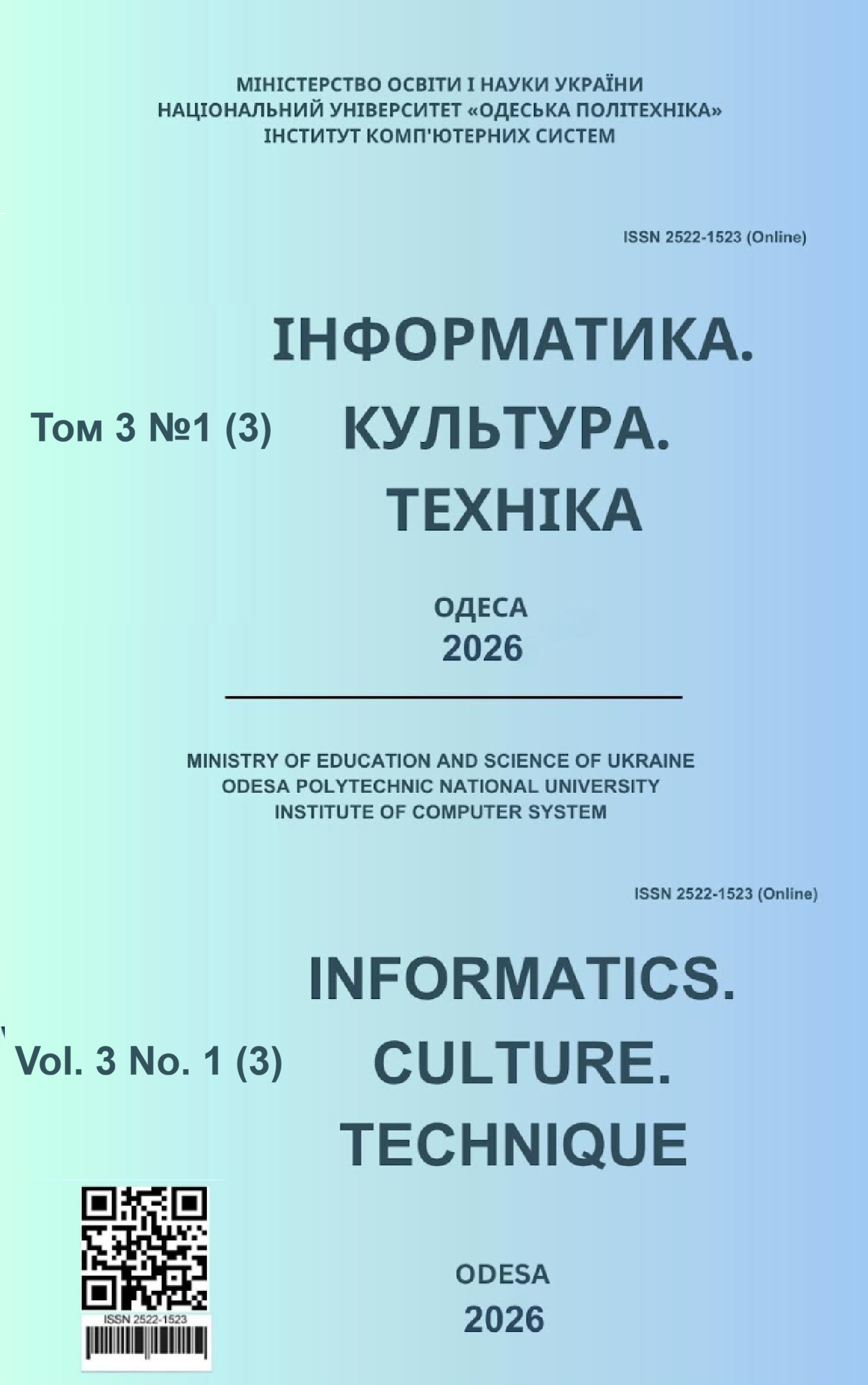
The journal “Informatics. Culture. Technology” is a peer-reviewed scholarly publication aimed at fostering a comprehensive understanding of information technology as a universal foundation for contemporary scientific and technological development and societal transformation
Published: 2026-09-08
Informatics and intelligent information technologies
Engineering, automation, and computer-integrated systems
Attention!
Manuscripts for the ХІІ International Scientific and Practical Conference "Informatics. Culture. Technology" (ICT) according to the template (in Ukrainian and English) are accepted from September 07, 2026 to September 25, 2026, with mandatory presentation and registration on the website
ХІІ International Scientific and Practical Conference "Informatics. Culture. Technology" will take place October 22–23, 2026 in online format
Articles submission
For registration problems, please contact the technical administrator:
Olga +38 (063) 9937234 (Viber, WhatsApp, Telegram) it.laboratoriyas@gmail.com
The journal Informatics. Culture. Technology is a peer-reviewed scientific publication that develops a systematic vision of information technologies as a universal foundation of modern scientific and technological development and social transformation. The journal is based on the understanding that informatics, digital culture, and technical systems do not exist in isolation, but rather form a unified integrated paradigm within which the processes of creation, formalization, processing, transmission, and interpretation of data and knowledge take place.
In this context, information technologies are regarded not merely as a set of computational tools and software implementations, but as a comprehensive scientific and engineering foundation of the digital era that determines the logic of development of modern information and intelligent systems, communication environments, technical infrastructures, and social interactions. The journal is focused on publishing research results that reflect the integration of theoretical models, software solutions, technical means, and socio-cultural practices, as well as demonstrate the practical application of information technologies in various fields of activity.
The editorial board of the journal is dedicated to ensuring a high level of scientific quality of publications, compliance with international academic standards, and continuous improvement of the journal, making it a reliable platform for disseminating scientific results and increasing the visibility of research within the global academic community.
Pursuant to Ministry of Education and Science Order No. 928 dated June 11, 2026 (Annex 7, item 46), the journal *Informatics. Culture. Technology* has been included in the List of Specialized Scientific Publications of Ukraine (Category B).
Specialization: Technical Sciences
The journal publishes articles in Ukrainian and English.
The journal publishes articles in the following specialties:
- Software Engineering (F2)
- Computer Science (F3)
- Systems Analysis and Data Science (F4)
- Cybersecurity and Information Protection (F5)
- Information Systems and Technologies (F6)
- Computer Engineering (F7)
- Automation, Computer-Integrated Technologies, and Robotics (G7)
DOI: https://doi.org/10.15276/ict
ISSN 2522-1523 (Online)
UDC 004.9
Website: https://ict.od.ua/
Year of Establishment: 2023
The journal is published three times a year (see details).
Founder: National University Odesa Polytechnic (op.edu.ua).
Publisher: National University Odesa Polytechnic, Institute of Computer Systems (link to publications: https://op.edu.ua/en/science/publications).
The electronic version of the journal is included in the V. I. Vernadskyi National Library of Ukraine.
Editorial Office Address:
1 Shevchenko Avenue, Journal Editorial Office, Room 5, Building 5, Odesa, 65044, Ukraine.
Phines: +38 (068) 2567847; +38 (063) 9937234
E-mail: julypjuxa@gmail.com; o.s.prigozheva@op.edu.ua
 Article materials may be used in accordance with the Creative Commons Attribution 4.0 International License (CC BY 4.0) with mandatory attribution to the author(s).
 The journal’s policy предусматривает strict adherence to the fundamental principles of publishing: scientific rigor, objectivity, professionalism, informational support for innovative research, unconditional fairness toward all authors, reviewers, and members of the editorial board, as well as the broad application of double-blind peer review involving objective and competent reviewers.
The journal’s policy also provides for continuous advisory support to authors aimed at improving the journal’s performance and meeting the requirements of international databases such as Scopus and Web of Science regarding the formatting and content of materials submitted for publication.